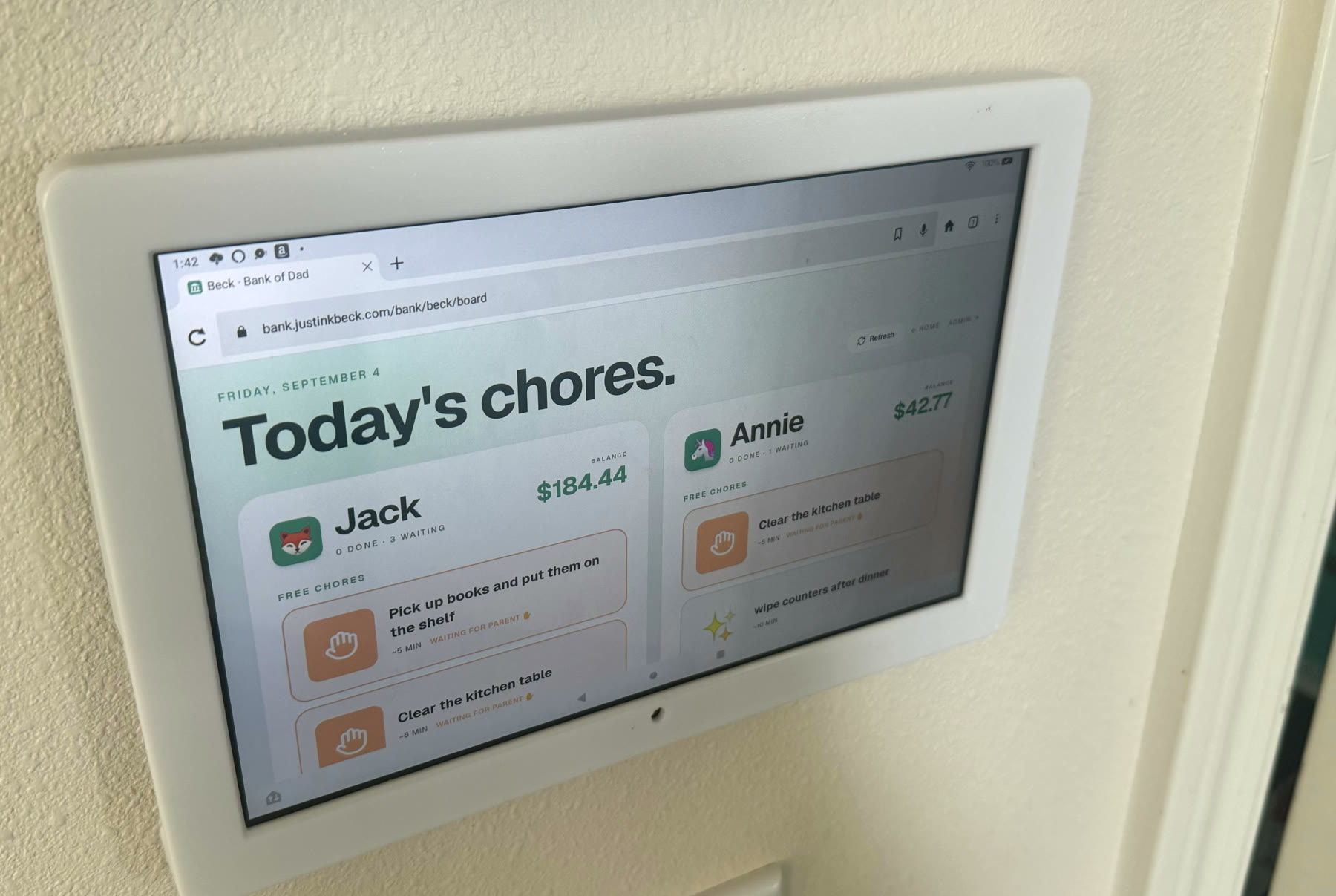
Chores they choose, a real ledger of dollars and cents, and interest every week. Kids from about four earn their own money, decide what to do with it, and watch what happens — while a bad call still costs fifty cents.
Jack
$184.44
Annie
$42.77
Lucy
$4.12
Why this is hard now
Coins in a jar. A wallet that got thinner. Now it's a tap on a phone, and by the time a kid gets a real account they've had no practice at all — their first lesson about overdrafting costs a hundred dollars instead of a quarter.
Bank of Dad puts money back where they can see it. Every cent they earn, save, spend and grow is in a ledger you both look at, from about age four.
Work, and the other kind of work
Paying for everything teaches a kid that helping is a transaction. Paying for nothing teaches them work is pointless. The board does both at once.
Free chores come first
Tidying up, laundry in the hamper, your own bed. Nobody gets paid for these — and the paid ones stay locked until the day's free ones are done.
Real jobs pay real money
A quarter for small stuff, fifty cents for real effort, a dollar for the grim ones. Small enough to be sustainable, big enough that a kid does the arithmetic.
Their call
Each kid gets their own board and decides what to do with it — all of it, one thing, or the litter box because it pays a dollar. Choosing is the part that builds judgement, and a kid who picked the job argues about it far less than one who was told.
You'll watch a four-year-old work out that two quarter-jobs beat one, entirely on their own. That's the whole thing working.
Annie's board
Thursday · pick any of them
And you don't have to invent it daily
You pick a pool of chores once, at signup. Every morning the app deals each kid a fresh handful at random, skipping whatever they did recently. No chore chart to maintain, no Sunday night wondering what to put on it — which is the reason most chore systems die in week three.
The daily loop
Free chores come first
Tidying up is just being part of the household. Those don't pay — and paid chores don't unlock until they're done.
The kid taps it done
On the family tablet. No login, no phone, no account. A ✋ shows it's waiting on you.
You check it off
Nothing moves until a parent approves — which is the accountability moment, and the reason the board gets looked at every day.
Cash or bank
Hand it over, or leave it in the bank to earn interest. Watching a kid choose the bank is the entire product.
Saving, and why it's worth it
So don't. Let them watch $20 they didn't spend turn into something they can't ignore, one Sunday at a time. Spending is always fun; this is how saving gets to be fun too.
Spent it on candy
$20.00
Left it in the bank · week 0
$20.00
You set the rate, and the app shows you exactly what it'll cost you before you commit to it. Most families start high where it's felt and taper it as balances grow.
What actually sticks
The money is the hook. The habits are the point — and they only form because somebody checks, every day, without it becoming a fight.
Getting the work done
A chore isn't finished because a kid says so — it's finished when you check it off. Thirty seconds a day, and it's the difference between a chore chart and a habit. Nothing pays out until you look.
Checking in on the money
Interest day gives the week a shape. Everyone opens the ledger, sees what grew, and has the same small conversation — which is how a kid ends up proud of a number going up instead of only excited about spending it.
Sunday · your inbox
This week at the bank
A summary lands every week so nobody has to remember to look, and we nudge you when claims pile up.
All of it, in one ledger
Birthday money, the twenty from grandma, the tooth fairy, the change from the couch. Deposit it and it's tracked with everything else — earning interest, visible, and no longer "I think Mom owes me twelve dollars".
When they want to buy something, you withdraw it and hand over the cash. They watch the number go down. That's budgeting, and it's a conversation you get to have at six instead of sixteen.
Jack's ledger
When they're ready
A lemonade stand with real books. The kids hold equity, not cash — so a $60 stand split three ways shows each of them $20, while the money stays in the business until they decide to pay themselves. Costs, revenue, profit, and a genuine argument about whether to reinvest.
Lemonade Stand
Cash on hand · $71.30
Jack
33.34%
$23.77
Annie
33.33%
$23.77
Lucy
33.33%
$23.76
Splits use largest-remainder rounding, so three ways always sums to the penny — never $23.76 × 3 = $71.28 with a cent quietly missing.
The part nobody tells you
One of them will hoard every cent and refuse to spend a dollar. One will burn it the same afternoon. One will do the maths on which chore pays best per minute and only do that one.
None of those are problems at six. They're information — and knowing it at six means you can coach the spender toward saving and the hoarder toward enjoying it, years before anyone's handed a credit card.
The saver
Watch they learn spending is allowed
The spender
Interest day is your lever
The optimiser
Give them the business
Add your kids, pick some chores, choose a rate. Everyone's first board is posted before you close the tab, and it takes about two minutes.
Set up your familyFree. No card. Your kids never sign up for anything.